Evaluating Chinese Character Illustrations: Balancing Cultural Authenticity with Modern 3D Design
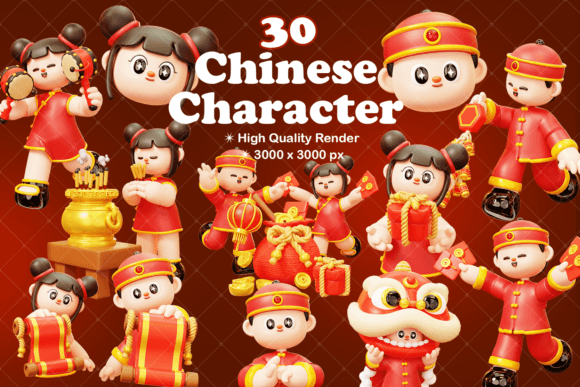
When selecting visual assets for projects involving East Asian themes, designers and crafters often face a distinct choice between traditional authenticity and contemporary appeal. The concept of the Chinese character extends far beyond simple typography; it encompasses a rich history of calligraphy, symbolic meaning, and cultural weight. However, in modern digital design and merchandise creation, there is a growing demand for stylized interpretations that bridge the gap between heritage and current aesthetic trends. A bundle featuring 30 cute cartoon 3D Chinese character illustrations represents a specific niche within this spectrum, offering a playful alternative to classical forms. Understanding where this style fits requires evaluating the tradeoffs between artistic expression, technical utility, and cultural representation.
Distinguishing Stylized 3D Art from Traditional Calligraphy
To make an informed decision, one must first distinguish between the functional use of Chinese characters as language and their use as decorative motifs. Traditional calligraphy prioritizes stroke order, balance, and historical accuracy. It is often monochromatic and carries a sense of solemnity or elegance. In contrast, 3D cartoon interpretations treat the character as a sculptural object rather than a written symbol. This shift changes the primary function of the asset from communication to decoration.
The 3D cartoon style introduces volume, lighting, and texture that flat vector art or ink brushwork cannot achieve. For audiences aged 20 to 50 exploring design options, this distinction is critical. If the goal is to convey a specific poetic meaning or adhere to strict cultural protocols, traditional vectors or licensed fonts are superior. However, if the objective is to create approachable, youthful, or festive content—such as Lunar New Year party supplies or casual apparel—the 3D aesthetic offers a warmth and accessibility that rigid traditional forms may lack. The "cute" factor serves as a cultural translator, making the imagery more versatile for international or mixed-audience contexts where deep linguistic literacy is not required.
Technical Considerations: High-Resolution PNG vs. Vector Formats
A significant decision factor when comparing illustration bundles is the file format. This specific package provides high-resolution PNG files at 3000 x 3000 pixels with transparent backgrounds. It is vital to compare this against the industry standard for print-on-demand and crafting, which often favors SVG (Scalable Vector Graphics) formats.
Advantages of the 3000px Raster Format:
- Texture and Depth: 3D renders rely on complex lighting, shadows, and material textures (like clay, plastic, or glass). These details are inherently raster-based. Converting true 3D renders to vectors often results in a loss of fidelity or an overly simplified appearance.
- Print Readiness: At 300 DPI, a 3000 x 3000 pixel image yields a crisp 10x10 inch print area. This is sufficient for most T-shirt designs, tote bags, wall art, and scrapbooking elements without requiring upscaling software.
- Software Compatibility: PNGs are universally supported. Users do not need specialized vector software like Adobe Illustrator or Cricut Design Space to utilize them effectively. They work seamlessly in Photoshop, Canva, Procreate, and standard office applications.
Limitations Compared to Vectors:
- Scaling Ceilings: Unlike SVGs, these PNGs cannot be resized infinitely. Enlarging them beyond their native resolution will result in pixelation. For large-format signage or billboards, this bundle would be unsuitable.
- No Cutting Paths: The absence of SVG files means these images are not optimized for vinyl cutting machines out-of-the-box. Crafters using Cricut or Silhouette for stickers or iron-ons will need to use auto-trace features or manual contouring tools to create cut lines around the 3D shapes.
- Editability: You cannot change the color of individual elements or adjust the lighting within a flattened PNG. If your project requires a specific brand color palette that differs from the rendered artwork, you may need to look for customizable 3D source files or recolorizable vectors instead.
Evaluating Fit for Merchandise and Digital Applications
The versatility of a 30-piece bundle lies in its breadth. When comparing this resource to single-image purchases or subscription services, the value proposition depends heavily on your intended application. For creators focusing on physical products, the 3D style offers distinct advantages over flat clipart.
For apparel and textiles, the dimensional quality of 3D characters mimics embroidery or puff print, even when printed via direct-to-garment (DTG) or sublimation. This creates a perceived higher value compared to flat 2D graphics. The transparent backgrounds facilitate easy placement on colored fabrics, though users should note that color variance between screen and fabric is inevitable. Testing prints is always recommended, especially with vibrant 3D renders where saturation levels can differ across devices.
For stationery and paper goods, the high resolution ensures that greeting cards and scrapbook layouts remain sharp. The playful nature of cartoon Chinese characters makes them particularly well-suited for educational materials for children, festive invitations, or personalized gifts. However, for formal wedding stationery or corporate branding, this style may be too informal. In those cases, minimalist line art or gold-foil textures would be more appropriate alternatives.
In web and social media design, 3000px assets provide ample room for cropping and composition. These illustrations can serve as engaging visual anchors in blog posts about culture, language learning apps, or holiday marketing campaigns. The lack of embedded text or quotes in this bundle is actually a strength here; it allows designers to pair the characters with their own typography, ensuring legibility and avoiding potential mistranslations that sometimes occur in pre-made text-art bundles.
Cultural Nuance and Audience Appropriateness
When incorporating Chinese characters into design, cultural sensitivity is a non-negotiable aspect of evaluation. Stylized 3D cartoons occupy a unique space. They are generally viewed as celebratory and pop-cultural rather than academic or religious. This makes them safer for general commercial use but potentially less suitable for contexts demanding reverence.
Buyers should verify the specific characters included in any bundle before purchase. While "cute" aesthetics are broadly appealing, certain characters carry specific auspicious meanings (e.g., fortune, longevity, happiness) while others may be neutral or context-dependent. A curated bundle of 30 typically focuses on positive, universally recognized symbols, but due diligence is necessary. If your project targets a native-speaking demographic, ensure the stylization has not distorted the character to the point of illegibility or unintended meaning. For non-native audiences, the visual vibe often supersedes literal reading, making this 3D style highly effective for conveying a general atmosphere of festivity and cultural appreciation.
Making the Final Selection Decision
Choosing this specific type of digital asset involves weighing convenience against customization. This bundle is an optimal choice for:
- Time-Sensitive Projects: Pre-rendered 3D assets save hours of modeling and lighting setup.
- Non-Vector Workflows: Designers who prefer raster editing or drag-and-drop platforms.
- Youth-Oriented or Festive Themes: Where approachability trumps formality.
- Multi-Use Licensing: When a single purchase needs to cover both digital content and physical merchandise.
Conversely, researchers and buyers should explore alternatives if:
- They require infinite scalability for large-format printing.
- They need to edit colors, angles, or expressions within the 3D model.
- The project demands strict traditional accuracy or formal calligraphic standards.
- Vinyl cutting is the primary production method and auto-tracing is not a viable workflow step.
Ultimately, the value of a 30 Cute Cartoon 3D Chinese Character Illustration Bundle is defined by its ability to modernize cultural symbolism for contemporary creators. By understanding the technical boundaries of high-res PNGs and the stylistic implications of 3D cartoon aesthetics, adults can confidently determine whether this resource aligns with their creative goals or if a different format better serves their specific needs. The key is to view these illustrations not as replacements for traditional art, but as complementary tools that expand the visual vocabulary available for cross-cultural design and personalization.