Evaluating Watercolor Lily Seamless Pattern 3 for Creative Projects
Selecting the right digital asset requires balancing aesthetic appeal with technical functionality. Watercolor Lily Seamless Pattern 3 represents a specific category of floral design resources that merges traditional artistic techniques with modern digital utility. For designers, crafters, and content creators, understanding the practical applications and limitations of this asset is essential before integration into a workflow. This evaluation explores the characteristics of this lily background, its technical specifications, and the decision-making factors relevant to various creative disciplines.
Defining the Asset and Technical Specifications
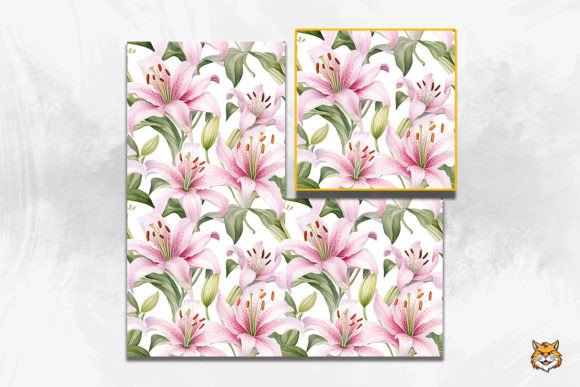
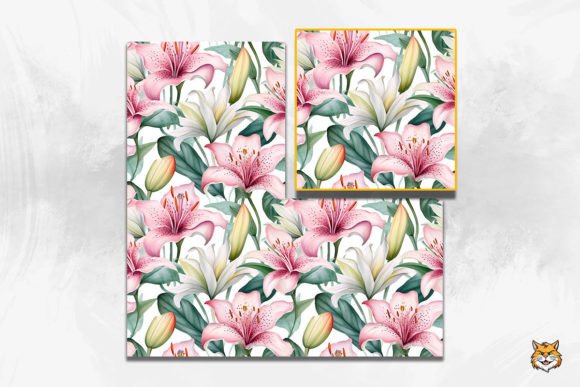
Watercolor Lily Seamless Pattern 3 is a digital texture file designed to repeat infinitely without visible seams or interruption. Unlike standalone illustrations, a seamless pattern allows for scalable coverage across surfaces of varying dimensions. The specific technical parameters of this asset define its utility ceiling. Delivered as a single ZIP file containing one PNG image, the file measures 12 inches by 12 inches at 300 DPI (dots per inch).
The 300 DPI resolution is the industry standard for high-quality printing, ensuring that the watercolor edges remain crisp and the color gradients do not appear pixelated when transferred to physical media. However, the 12x12 inch tile size presents specific considerations. While sufficient for most stationery and scrapbooking projects, larger format printing may require careful tiling management to avoid repetitive visual artifacts. The PNG format supports transparency and lossless compression, making it superior to JPEG for maintaining the integrity of delicate watercolor washes, though it results in a larger file size compared to vector alternatives.
Aesthetic Versatility and Application Fit
The primary value proposition of this lily seamless pattern lies in its stylistic versatility. Watercolor florals occupy a middle ground between rigid geometric designs and chaotic organic imagery. This makes the Watercolor Lily Seamless Pattern 3 particularly effective for projects requiring a soft, elegant, or naturalistic tone without overwhelming the foreground content.
- Stationery and Invitations: The 12x12 inch scale aligns perfectly with standard invitation sizes. The pattern serves as an ideal lily background for wedding suites, baby showers, or spring event branding where legibility of overlaid text is paramount.
- Digital Interfaces: As a web background or social media banner, the seamless nature ensures consistent branding across different screen aspect ratios. The organic texture adds depth to flat digital layouts.
- Physical Crafts: For scrapbooking and card making, the high resolution allows for cropping and zooming. Users can isolate specific lily elements from the larger bundle composition to create custom focal points.
- Packaging and Wraps: When used as a wrap for candles, soap, or small boxes, the repeating lily wallpaper effect creates a cohesive product presentation.
Tradeoffs and Technical Considerations
While Watercolor Lily Seamless Pattern 3 offers significant utility, objective evaluation requires acknowledging its constraints relative to other asset types. Understanding these tradeoffs prevents frustration during the production phase.
Raster vs. Vector Limitations
This asset is a raster image (PNG), not a vector file. Vectors are mathematically defined and can be scaled infinitely without quality loss. In contrast, this 300 DPI PNG has a fixed pixel dimension. Scaling the pattern up beyond 100% will result in interpolation and softness. If a project requires a billboard-sized lily background or massive environmental graphics, this specific 12x12 inch file may be insufficient. Designers needing infinite scalability should seek SVG or AI formats instead.
Color Editing Flexibility
Watercolor textures often feature complex color blending and transparency that can be difficult to modify in post-production. Unlike flat graphic patterns where colors can be swapped instantly via hue/saturation adjustments, altering the palette of Watercolor Lily Seamless Pattern 3 may degrade the natural look of the paint bleeds. Users should evaluate whether the existing colorway aligns with their brand guidelines before purchase, as significant recoloring efforts may yield suboptimal results.
File Format Specifics
The delivery of a single PNG file simplifies organization but limits editing layers. If the user intends to rearrange individual lilies or adjust the spacing of the seamless pattern, they cannot do so with this flattened file. This asset is best suited for users who accept the composition as-is rather than those looking for a customizable lily bundle kit with separated elements.
Situational Suitability Analysis
Determining whether Watercolor Lily Seamless Pattern 3 is the correct choice depends heavily on the end goal. The following framework assists in matching the asset to specific project requirements.
When This Asset Is a Strong Fit
This pattern excels in mid-scale print and digital applications where texture enhances rather than dominates. It is optimal for:
- Standard Commercial Printing: Business cards, flyers, and greeting cards fall well within the 300 DPI safety zone.
- Text-Heavy Designs: The watercolor style typically features lower contrast in negative spaces, providing excellent readability for typography overlays.
- Quick Turnaround Projects: Because the file is pre-tiled and high-resolution, it eliminates the time spent creating custom repeats or scanning physical paintings.
- Cohesive Branding Kits: Using the same lily wallpaper across social banners, website headers, and printed collateral creates immediate visual consistency.
When Alternatives Are Worth Considering
Evaluators should look elsewhere if the project demands:
- Large Format Signage: Trade show booths or vehicle wraps require higher native resolutions or vector graphics to avoid blurriness.
- Custom Compositional Control: If the design requires moving individual flowers or changing the density of the lily seamless pattern, a layered PSD or modular bundle is necessary.
- Strict Color Matching: Projects with rigid Pantone requirements may struggle with the inherent variability of digitized watercolor art.
- 3D Rendering Textures: While some users search for "Lilyr 3D" or 3D mapping assets, a standard 2D PNG lacks the normal maps, displacement maps, or alpha channels required for realistic 3D rendering software. Specialized texture packs are recommended for 3D modeling workflows.
Practical Decision-Making Insights
For professionals and hobbyists evaluating Watercolor Lily Seamless Pattern 3 alongside other options, the decision ultimately rests on the intersection of resolution needs and aesthetic preference. The 12x12 inch, 300 DPI specification serves as a reliable benchmark for general-purpose design work. It covers the vast majority of consumer and small-business printing needs while remaining lightweight enough for web optimization.
Users should verify their output dimensions against the source file size before committing. A simple calculation—dividing the intended print size by 12 inches—reveals the scaling factor. If the scale exceeds 1.5x, quality degradation becomes likely. Conversely, for digital-only use, this resolution provides ample headroom for cropping and responsive resizing.
Furthermore, consider the licensing and usage rights associated with the shop. While the technical specs determine feasibility, the legal terms determine viability for commercial versus personal use. Ensuring alignment between the asset's capabilities and the project's scope prevents wasted budget and production delays. By objectively assessing these factors, creators can confidently determine if this specific lily background fulfills their creative and technical objectives.