Elevating Digital and Print Projects with 3D Mandala Art Style Backgrounds
The evolution of digital design has transformed how we perceive traditional artistic patterns. While mandalas have served as spiritual and decorative symbols for centuries, the modern interpretation brings a new dimension to creative workflows. A 3D of Mandala Art Style Background offers a unique fusion of ancient symmetry and contemporary depth perception. Unlike flat vector graphics, these high-resolution raster images provide texture, shadow, and lighting effects that mimic physical relief or intricate paper carving. For designers, crafters, and content creators, understanding the technical specifications and practical applications of this specific asset is essential for achieving professional results in both digital and physical mediums.
Technical Specifications and Resolution Standards
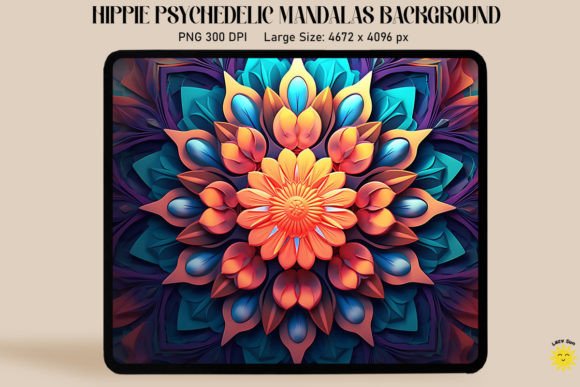
When integrating complex visual elements into a project, file integrity is paramount. The primary value proposition of this specific 3D of Mandala Art Style Background lies in its substantial pixel dimensions. Measuring approximately 4672 x 4096 pixels, this asset exceeds standard screen resolution requirements significantly. This excess capacity is not merely about size; it is about flexibility. In professional graphic design, starting with a canvas larger than your final output ensures that resizing down never results in pixelation or artifacting.
The file is delivered at 300 DPI (dots per inch), which is the industry benchmark for high-quality printing. Many web-only assets are saved at 72 DPI, making them unsuitable for physical products. By adhering to the 300 DPI standard, this PNG file bridges the gap between digital display and tangible goods. Whether you are designing a small business card or a large-format banner, the resolution supports crisp edges and smooth gradients. It is important to note that while the dimensions are approximate, the aspect ratio allows for versatile cropping without compromising the central focal point of the mandala design.
Understanding the PNG Format in Design Workflows
This product is supplied as a single PNG file within a ZIP archive. Choosing PNG over other formats like JPEG is a deliberate decision for this type of artwork. Mandalas often feature intricate negative space and semi-transparent elements that require lossless compression. JPEG compression can introduce "noise" around fine lines and high-contrast edges, which detracts from the meditative precision of mandala art. PNG preserves every pixel exactly as rendered, maintaining the integrity of the 3D shading and highlights.
However, users must distinguish this format from vector graphics. This is not an SVG file, nor is it layered for cutting machines like Cricut or Silhouette. It is a flattened raster image. This distinction matters immensely for workflow planning. If your goal is to isolate individual petals for laser cutting, this file requires additional processing in software like Photoshop or GIMP. Conversely, if your goal is to use the image as a complete background, overlay, or print-ready element, the flattened PNG format is actually superior because it guarantees the visual appearance remains consistent across different devices and software platforms.
Practical Applications Across Creative Industries
The versatility of a 3D of Mandala Art Style Background extends far beyond simple decoration. Its application varies significantly depending on the medium and the intended audience. Understanding these use cases helps maximize the return on investment for digital assets.
Digital Media and Web Presence
In the digital realm, engagement is often driven by visual richness. Social media banners, YouTube thumbnails, and website hero sections benefit from the depth provided by 3D rendering. Flat designs can sometimes appear sterile on high-definition screens, whereas the simulated lighting in this mandala style creates a sense of tactility that draws the eye. Because the file is high-resolution, it serves excellently as a retina-display background for websites, ensuring that users on mobile devices and desktop monitors alike experience sharp imagery. When used as a web background, designers often apply a slight opacity reduction or color overlay to ensure text readability while retaining the aesthetic complexity underneath.
Print Products and Stationery
For the stationery and invitation market, texture implies luxury. A 3D mandala background simulates embossing or foil stamping without the associated manufacturing costs. This makes it an ideal choice for DIY wedding invitations, greeting cards, and scrapbooking. When printed on matte cardstock, the shadows within the design create an optical illusion of raised surfaces. Crafters utilizing this asset for sublimation printing will find the 300 DPI resolution sufficient for transferring vibrant, detailed images onto mugs, tumblers, and textiles. The key consideration here is color management; because colors vary between monitors and printers, performing a test print is always recommended to calibrate expectations.
Navigating File Management and Color Accuracy
Adopting high-resolution digital assets requires a baseline of technical proficiency. Since this product arrives in a .ZIP container, users must be comfortable with file extraction on their specific operating system, whether PC or Mac. Failing to unzip the file before attempting to open it is a common error that leads to confusion. Once extracted, proper file organization prevents future workflow bottlenecks. Renaming the generic file to something descriptive, such as "3D_Mandala_Gold_4k.png," aids in searchable asset libraries.
Color fidelity is another critical factor. Digital screens emit light using RGB color profiles, while printers reflect light using CMYK inks. A 3D of Mandala Art Style Background viewed on a calibrated monitor may appear more luminous than the same file printed on uncoated paper. This is not a defect of the file but a characteristic of the medium. Designers should utilize soft-proofing features in their editing software to predict how the 3D shadows and highlights will translate to ink. For those using the design for digital-only projects, ensuring your workspace is set to sRGB or Display P3 will maintain consistency across various browsers and social media platforms.
Resizing Strategies and Quality Preservation
One of the most significant advantages of starting with a 4672 x 4096 px canvas is the ability to scale. However, scaling requires intention. Reducing the image size for a business card or Instagram post is safe and often improves perceived sharpness due to pixel density. Upscaling, however, demands caution. While modern AI upscaling tools exist, they can sometimes hallucinate details in geometric patterns, distorting the mathematical precision of the mandala.
If a project requires dimensions larger than the native file size, it is better to use the mandala as a repeating pattern or a border element rather than stretching the single image. Alternatively, combining this high-res background with solid color blocks or complementary textures can extend the design's reach without sacrificing quality. The "approximate" nature of the dimensions mentioned in the product specs suggests a margin of safety; designers should always verify exact pixel counts upon opening the file rather than assuming the stated dimensions are absolute, as minor variations can occur during export processes.
Integrating Raster Art into Modern Design Systems
In an era dominated by scalable vectors, there is a resurgence of appreciation for raster-based artistic expression. Vectors offer infinite scalability but often lack organic nuance. A 3D of Mandala Art Style Background introduces controlled imperfection and rendered lighting that vectors struggle to replicate efficiently. Integrating this asset into a broader design system involves treating it as a foundational texture layer.
For brand identities focusing on wellness, spirituality, or artisanal craftsmanship, this style communicates values instantly. It pairs exceptionally well with serif typography and minimalist layouts, where the complexity of the background balances the simplicity of the foreground content. When selecting this asset, consider the negative space. Some 3D mandalas are dense edge-to-edge, suitable for full-bleed prints, while others feature a centralized composition better suited for framed art or centered web headers. Assessing the composition relative to your specific project needs ensures the asset enhances rather than overwhelms the final design.
Ultimately, the successful utilization of this digital product hinges on respecting its technical boundaries and leveraging its artistic strengths. By understanding the interplay between resolution, format, and application, creators can transform a simple PNG file into a cornerstone of compelling visual communication. Whether for a personal scrapbook page or a commercial packaging design, the depth and detail inherent in this style provide a rich canvas for creativity, provided the user approaches the file with the appropriate technical knowledge and artistic intent.